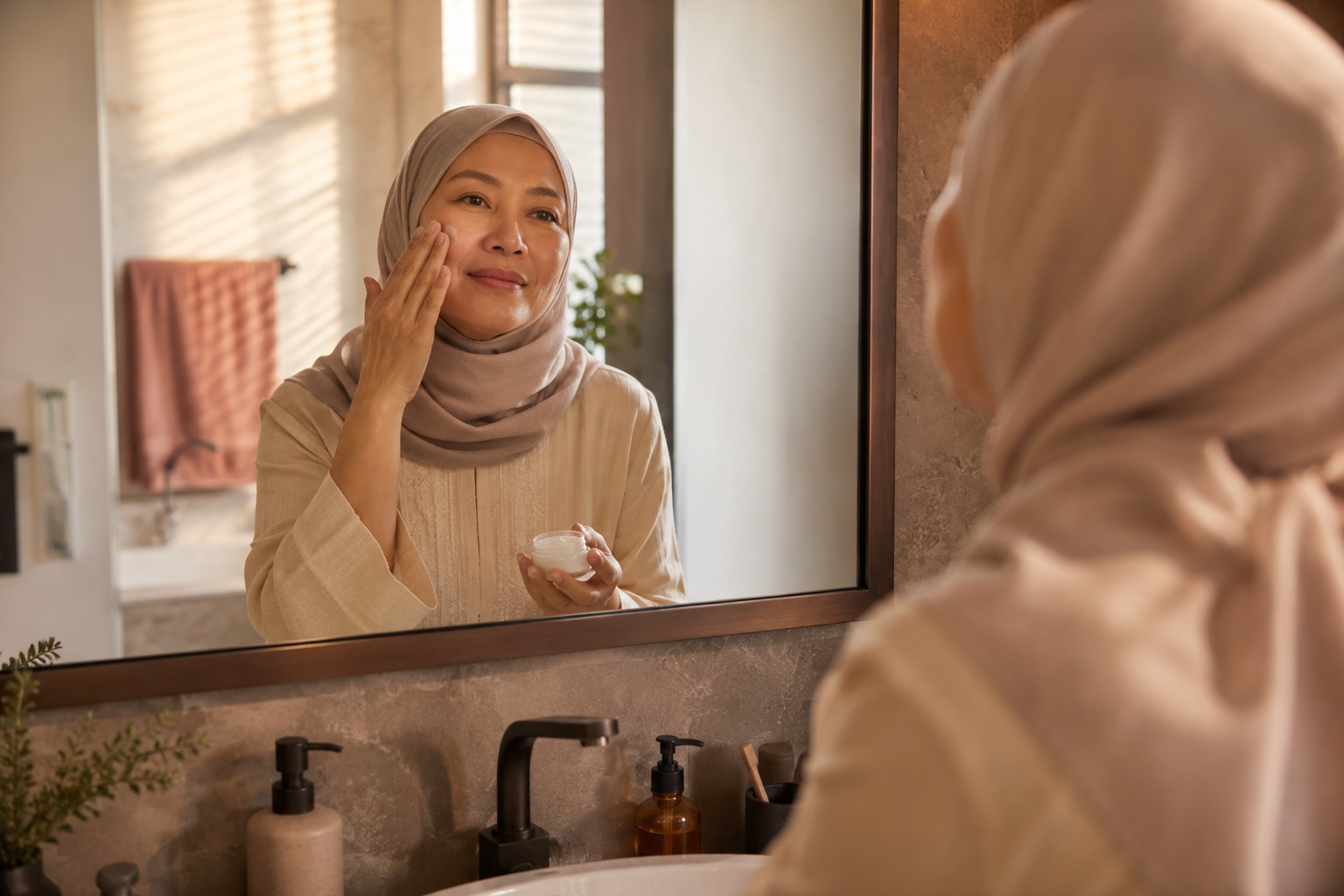
The short answer: the skin changes of perimenopause, sudden dryness, thinner and less springy skin, new sensitivity, and sometimes adult acne, are driven by falling estrogen (oestrogen), which is a major regulator of collagen, oil production and the skin barrier. They are distinct from ordinary sun-and-age skin changes, and they can happen surprisingly fast: research suggests women can lose a large share of their skin collagen in the first years after menopause. That speed is the reason to respond deliberately rather than waiting. The good news is that the most effective responses are well established: sun protection, a barrier-supporting routine, evidence-based ingredients like retinoids, and, for some women, the skin benefits that come alongside hormone therapy.
Something looks different in the mirror, and it is not only the lines. The texture has changed, the skin feels drier and somehow less resilient, products that were fine for years suddenly sting, and a crop of spots has appeared along the jaw for the first time since your teens. These are not your imagination, and they are not simply “getting older” in the way your skin aged through your thirties. They track a specific hormonal shift, and understanding that shift is what lets you choose treatments that address the cause rather than chasing symptoms with whatever is trending.
What estrogen does for skin
Estrogen is one of the most important hormones for skin, and its influence is easy to underestimate until it falls. It drives the production of collagen, the structural protein that gives skin its thickness, firmness and plumpness, and of elastin, which lets skin spring back. It boosts the skin’s ability to hold water, partly by supporting hyaluronic acid and the lipids that make up the moisture barrier. It regulates the activity of the oil (sebaceous) glands. And it supports wound healing and the skin’s blood supply. In short, a great deal of what we think of as “youthful” skin is estrogen at work.
So when estrogen declines through perimenopause, several of these functions fade at once. Collagen production slows, so skin thins and loses firmness; the barrier weakens and holds less water, so skin dries; oil production drops in most women, adding to the dryness; and healing and resilience decline. The often-quoted research finding is striking: studies suggest women lose around 30 percent of skin collagen in the first five years after menopause, then more gradually after that. That front-loaded loss is why the change can feel abrupt, arriving over a year or two rather than creeping in slowly.
The specific changes, and what drives each
Dryness and dullness. With less oil and a weaker barrier, skin loses water more easily and can feel tight, rough or flaky. This is where your routine needs to change: humectants like hyaluronic acid and glycerin draw in water, while occlusive and barrier-repairing ingredients such as ceramides and richer creams seal it in. Heavier moisturisers that felt greasy in your thirties are often exactly right now.
Loss of firmness and texture. Collagen and elastin loss reduces skin density and elasticity, so fine lines deepen and skin looks less plump. The most evidence-supported topical response is a retinoid, either prescription tretinoin or over-the-counter retinol, which stimulates collagen and improves texture over months of consistent use. Vitamin C supports collagen synthesis and adds antioxidant protection. And the single most powerful anti-ageing step remains daily broad-spectrum sunscreen, because ultraviolet light drives the majority of visible skin ageing and accelerates the collagen loss already underway.
New sensitivity. A weakened barrier makes many women’s skin more reactive, prone to redness, stinging and flare-ups from products that never caused trouble before. The right move is counterintuitive: simplify. Strip the routine back to a gentle cleanser, a barrier-supporting moisturiser and sunscreen, let the skin settle, then reintroduce active ingredients one at a time and slowly. More products are not the answer to reactive skin; fewer, better-chosen ones usually are.
Why acne can come back at 40
One of the more disorienting perimenopausal skin changes is acne, often after decades of clear skin. It typically appears along the lower face, the jawline, chin and neck, and tends to be deeper and more inflamed than teenage spots. The mechanism is the changing balance between estrogen and androgens. As estrogen fluctuates and falls, the relative influence of androgens (like testosterone) on the skin rises, and androgens stimulate the oil glands, which combined with the changes in skin cell turnover can drive breakouts. It is the same hormonal shift that underlies perimenopausal hair thinning, seen from the other side.
Because the driver is hormonal rather than simply excess oil and bacteria, perimenopausal acne often does not respond well to harsh teenage-acne tactics, which can strip and irritate already-fragile skin and make things worse. Gentler evidence-based options, topical retinoids, azelaic acid, and, where appropriate, prescription treatments including hormonal ones, tend to work better. This is a good moment to see a dermatologist rather than escalating aggressive over-the-counter products, because the right approach is specific to this hormonal context.
Does hormone therapy help skin?
Many women notice their skin improves on hormone therapy, with better moisture, thickness and elasticity, which is entirely consistent with estrogen’s central role in collagen and barrier function. Studies of estrogen and skin support this, showing increases in collagen content and skin hydration with treatment. It is a genuine and welcome effect.
The important caveat is one of framing. Improved skin is a secondary benefit of hormone therapy, not a reason to take it on its own, and HRT is prescribed on the basis of your symptoms and health profile rather than as a cosmetic treatment. But if you are already weighing hormone therapy for hot flashes, sleep or mood, the skin benefit is a legitimate part of the overall picture worth noting. Our explainers on what HRT involves and its safety on current evidence give the background for that conversation.
The routine and habits that actually help
Pulling it together, a sensible perimenopausal skin approach is simpler than the marketing suggests. Cleanse gently, without stripping. Use a moisturiser built around humectants and barrier lipids like ceramides. Apply broad-spectrum sunscreen every day, which does more for long-term skin than any serum. Add a retinoid at night, starting low and infrequent and building up, for collagen and texture, and consider a vitamin C antioxidant in the morning. Reintroduce or add actives one at a time so you can tell what your now-more-reactive skin tolerates.
The inside matters too. Skin reflects hydration, so drink enough water; omega-3 fats support the barrier; vitamin C is needed to build collagen; and protein supplies the building blocks. Reducing sugar and alcohol has well-documented benefits for skin quality, and not smoking is one of the strongest things you can do, since smoking accelerates collagen breakdown. Our nutrition framework covers the dietary side, and it happens to overlap almost entirely with what benefits bones, heart and metabolism, so it is not a separate effort.
The ingredients worth knowing
If the skincare aisle feels overwhelming, only a handful of ingredients have real evidence for perimenopausal skin. This is what each one does and when to use it, so you can build a short routine rather than a long one.
| Ingredient | What it does | When |
|---|---|---|
| Broad-spectrum sunscreen | Prevents most visible ageing; protects collagen | Every morning, non-negotiable |
| Retinoid (retinol or tretinoin) | Stimulates collagen, improves texture | Night, start low and build up |
| Vitamin C | Supports collagen, antioxidant protection | Morning, under sunscreen |
| Hyaluronic acid and glycerin | Draw water into the skin | Any time, on damp skin |
| Ceramides | Repair and seal the moisture barrier | Morning and night in your moisturiser |
| Niacinamide | Calms redness, strengthens the barrier | Helpful for new sensitivity, morning or night |
| Azelaic acid | Eases hormonal breakouts and redness gently | Night, for jawline acne |
You do not need all of these at once. Sunscreen, a barrier moisturiser and a retinoid are the core; the rest are targeted additions for dryness, sensitivity or acne.
If skin changes are bothering you, a menopause-informed clinician can help you find an approach that fits. Yellow’s practitioner directory is a good starting point.
Frequently Asked Questions
Why is my skin so dry suddenly in my forties?
Estrogen supports oil production and the skin’s moisture barrier, and as it declines in perimenopause the skin produces less oil and holds less water, so dryness can arrive relatively quickly. Switching to richer moisturisers built around humectants like hyaluronic acid and barrier-repairing ceramides, and avoiding stripping cleansers and long hot showers, makes a real difference.
Can I use retinol during perimenopause?
Yes, and it is one of the most evidence-supported topical ingredients for supporting collagen and improving texture, so it is well suited to this stage. Start with a low strength (around 0.025 to 0.05 percent) a couple of nights a week and build up gradually to avoid irritating now-more-sensitive skin, and always pair it with daily sunscreen. Prescription tretinoin is stronger and needs a doctor or dermatologist.
Why am I getting acne in my forties?
Perimenopausal hormonal fluctuations shift the balance between estrogen and androgens, and the relative rise in androgen activity stimulates the oil glands, driving breakouts, characteristically along the jaw, chin and neck. Because the cause is hormonal rather than teenage-style oiliness, harsh acne products often make it worse, and gentler or prescription approaches work better, so it is worth seeing a dermatologist.
Does collagen supplementation help skin?
The evidence is modest but growing. Some studies of hydrolysed collagen peptides show small improvements in skin hydration and elasticity with consistent daily use over a couple of months. It is not transformative and will not replace sun protection or retinoids, but it is generally safe and low-risk if you want to try it. A protein-adequate, vitamin-C-rich diet supports collagen from the inside regardless.
Does what I eat affect my skin in perimenopause?
Yes, at the margins. Staying well hydrated, getting omega-3 fats to support the skin barrier, and enough vitamin C for collagen synthesis all help, while high sugar intake and alcohol have well-documented negative effects on skin quality. Diet will not override the hormonal changes or replace topical care and sunscreen, but it is a genuine supporting factor and overlaps with eating well for the rest of the body.
Is it worth seeing a dermatologist, or can I manage skin changes myself?
Many perimenopausal skin changes, dryness, mild texture changes, can be managed well with a simplified routine, sunscreen and a retinoid. It is worth seeing a dermatologist if you develop persistent adult acne, marked new sensitivity or rashes, or any changing or unusual lesion, because these benefit from tailored assessment and, in the case of acne, treatments specific to the hormonal context that outperform over-the-counter options.
Further Reading
- American Academy of Dermatology. Caring for your skin in menopause. https://www.aad.org/public/everyday-care/skin-care-secrets/anti-aging/skin-care-during-menopause
- The Menopause Society. Skin and hair changes during the transition. https://menopause.org/patient-education/menopause-topics
- NHS. Menopause symptoms. https://www.nhs.uk/conditions/menopause/symptoms/
- British Association of Dermatologists. Skin and the menopause. https://www.bad.org.uk/patient-information-leaflets/
- Journal studies on estrogen and skin collagen. https://pubmed.ncbi.nlm.nih.gov/
This article is for general information and does not constitute medical advice. Skin conditions vary, and any new, changing or persistent lesion should be assessed. For troublesome acne, sensitivity or other skin concerns, please consult a qualified healthcare professional or dermatologist.