The short answer: If you are a woman over 45, strength training is one of the most useful things you can do for the body you want to have in 10, 20 or 30 years. As we get older we naturally lose muscle, and around menopause the fall in oestrogen can speed up bone loss, so keeping muscles and bones strong matters more than ever. You do not need a gym or heavy machines. You can start at home with your own body weight, resistance bands or a pair of dumbbells, and two or three short sessions a week can make a real difference. It is not too late to get stronger after menopause, and consistency matters more than intensity: a short session you do regularly beats a hard programme you give up after three weeks. Strength training is not about fighting ageing. It is about giving yourself the best chance of ageing well, so you can carry your own shopping, climb stairs, get up off the floor and stay independent.
For many years, women have been told to exercise to lose weight, stay slim or look younger. But after 45, I think we need to look at exercise in a different way.
Of course, we all want to feel good in our bodies. But there is another question that becomes more important as we get older:
What do I want my body to be able to do in 10, 20 or 30 years?
I want to be able to carry my shopping bags. I want to climb stairs easily. I want to get down on the floor and get back up without thinking about it. I want to travel, walk, practise yoga and stay independent for as long as possible.
And this is why strength training matters so much.
What happens to our muscles after 40?
As we get older, we naturally start to lose muscle. For women, the years around menopause can make this even more important. Hormonal changes can affect our muscles and our bones, and we may also notice changes in our body and our energy.
But losing strength as we age is not something we simply have to accept. We can do something about it.
Our muscles need to work to stay strong. And they need to be challenged.
This is where strength training comes in.
“But I walk and I do yoga…”
I hear this a lot. And my answer is always: that’s wonderful. Keep doing it!
I love walking and I am a yoga teacher, so yoga is obviously a big part of my life. Walking is excellent for our health and our mood. Yoga can help us stay mobile, improve our balance, breathe better and feel more connected to our bodies.
But I don’t believe we should choose between walking, yoga and strength training. We need different types of movement.
Walking helps us keep moving. Yoga helps us with mobility, balance and body awareness. Strength training helps us stay strong.
They work very well together.
Strength training doesn’t have to mean going to the gym
When I talk to women about strength training, some immediately imagine a gym full of machines and very heavy weights. It doesn’t have to be like that. You can start at home.
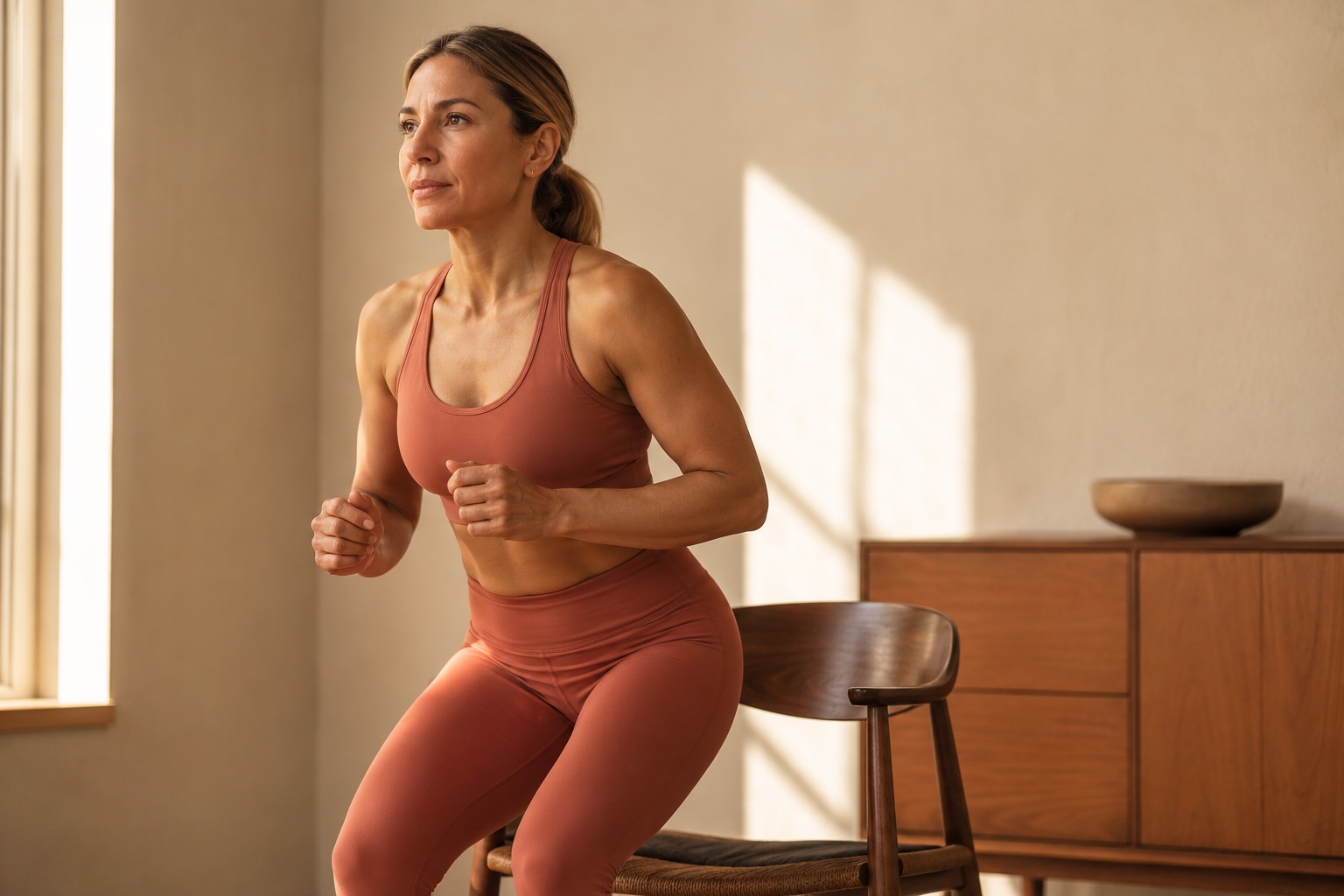
You can use your own body weight, resistance bands or a pair of dumbbells. Sitting down on a chair and standing up again is already a strength exercise. Squats, lunges, pushing, pulling and carrying things are all movements we use in everyday life.
The important thing is to start at your own level. Then, little by little, you make the exercise more difficult as you get stronger.
And yes, you can get stronger after menopause. It is not too late.
Strong muscles, but also strong bones
There is another reason why I talk so much about strength with women over 45: our bones. Around menopause, the fall in oestrogen can speed up bone loss. This is why bone health becomes especially important at this time of life.
Strength training challenges our muscles and puts load on our bones. This can help us maintain muscle strength and support bone health as we get older.
For me, this changes the way we look at exercise. We are not only exercising for the body we have today. We are also preparing the body we want to have at 70 or 80.
You don’t need to train every day
The good news is that you don’t need to spend hours exercising. Two or three strength sessions a week can make a real difference, and they don’t have to be long.
Start with simple exercises. Learn how to do them well. Give your body time to adapt. Then slowly add more weight or resistance when you feel ready.
And don’t forget rest. At midlife, I think we sometimes need to stop believing that more exercise is always better.
A short session that you do regularly is much more useful than a very hard programme that you give up after three weeks.
What are you training for?
This is the question I would love more women to ask themselves. Not: “How can I make my body look younger?” But: “What am I training my body to be able to do?”
Maybe you want to hike when you’re 70. Maybe you want to travel. Maybe you want to play with your grandchildren. Maybe you simply want to carry your own suitcase or get up from the floor easily.
These things may seem small today. But one day, they may be the difference between needing help and staying independent.
For me, this is what strength training after 45 is really about. It is not about fighting ageing. It is about giving ourselves the best chance of ageing well.
Growing older is inevitable. Growing weaker doesn’t have to be.
About the author
Isabelle Kehr is a yoga teacher and menopause wellness coach who helps women move, feel stronger and approach midlife with more confidence. She teaches that walking, yoga and strength training work best together, and that it is never too late to build strength. Find her at isabellekehr.com and on Instagram @_isabel_kehr.
Frequently Asked Questions
Is it too late to start strength training after menopause?
No. You can get stronger after menopause, and it is not too late. As we get older we naturally lose muscle, and muscles need to be challenged to stay strong. Start at your own level, then make the exercises a little harder as you get stronger. Even that is enough to make a real difference.
Do I need to go to the gym to do strength training?
No. Strength training does not have to mean machines and very heavy weights. You can start at home using your own body weight, resistance bands or a pair of dumbbells. Sitting down on a chair and standing up again is already a strength exercise, along with squats, lunges, pushing, pulling and carrying.
How many days a week should I strength train?
Two or three sessions a week can make a real difference, and they do not have to be long. Start with simple exercises, learn to do them well, and add more weight or resistance when you feel ready. A short session you do regularly is more useful than a hard programme you give up after three weeks.
I already walk and do yoga. Isn’t that enough?
Walking and yoga are excellent and worth keeping. Walking helps you keep moving, and yoga supports mobility, balance and body awareness. But they are a different type of movement to strength training, which is what helps you stay strong. They work best together. Yellow’s guide to exercise in perimenopause explains how the different types fit together.
Why does strength training matter for my bones?
Around menopause, the fall in oestrogen can speed up bone loss, so bone health becomes especially important. Strength training challenges your muscles and puts load on your bones, which helps maintain muscle strength and support bone health as you get older. Yellow’s guide to menopause and bone density covers this in more detail.
What should I actually be training for at this age?
The more useful question is not how to look younger, but what you want your body to be able to do. That might be hiking at 70, travelling, playing with grandchildren, or simply carrying your own suitcase and getting up off the floor. Strength training helps protect the independence those everyday things depend on.
Further Reading & Sources
- González-Gálvez N, et al. Effects of resistance training on physical fitness and function in postmenopausal women. Climacteric, 2024. https://doi.org/10.1080/13697137.2024.2310521
- Sá KMM, et al. Resistance training for postmenopausal women: functional capacity and bone density. Menopause, 2023. https://journals.lww.com/menopausejournal/abstract/10.1097/gme.0000000000002079~resistance-training-for-postmenopausal-women-systematic
- Endocrine Society. Menopause and Bone Loss. https://www.endocrine.org/patient-engagement/endocrine-library/menopause-and-bone-loss
- National Institute for Health and Care Excellence (NICE). Menopause: diagnosis and management (NG23). https://www.nice.org.uk/guidance/ng23
- NHS. Physical activity guidelines for adults aged 19 to 64. https://www.nhs.uk/live-well/exercise/exercise-guidelines/physical-activity-guidelines-for-adults-aged-19-to-64/
This article is for general information and is not medical advice. It is not a recommendation to take or avoid any specific treatment, including HRT. Speak with a qualified practitioner before starting a new exercise programme, particularly if you have an existing health condition or injury.